Induction heating: seized nuts, glass and bonded parts
A wheel nut welded on by rust, an exhaust bolt that won't budge, a bonded badge you don't want to scratch. An induction heater sorts out these situations without a torch, without a flame and without burning what's around it. You still need to know what it does well, and what it doesn't.
How an induction coil heats
The tool passes a high-frequency alternating current through a coil. This current creates a magnetic field that induces currents inside the metal part placed in the coil. It's the part itself that heats up, from the inside, not the coil passing on its heat. The result: a nut can glow red in a few seconds while the plastic two centimetres away stays almost cold.
Induction works very well on steel and cast iron, which are magnetic. It is much less effective on aluminium, copper or austenitic stainless steel. So it's not a universal tool, but on steel fasteners it's formidable.
Compared with a gas torch, the difference in a bodyshop is enormous. No gas bottles to store and move around, no flame near a fuel tank, a loom or a trim panel, and heat concentrated on the target part instead of everything around it. For a workshop doing bodywork and a bit of mechanical work, it's a tool that pays for itself quickly: every snapped nut or stripped stud avoided means half an hour less drilling and tapping.
Freeing a seized nut or bolt
Choose the coil whose diameter fits as closely as possible around the nut without touching it. Heat the nut, not the bolt: as it expands, it gains clearance and breaks the rust bonding it to the thread. A few seconds is usually enough. Undo it while hot, with a socket in good condition, and it often comes away first time.
For hard-to-reach parts, the flexible coil wraps around a bolt, a stud or a drop link. Think about what's behind: a hose, a loom, a gaiter, a tank or a brake pipe must not end up in contact with a part at several hundred degrees. The absence of a flame greatly reduces the risks; it doesn't eliminate them.
A workshop tip: on a broken bolt or a heavily rusted stud, heat, let it cool a little, then heat again. These cycles of expansion and contraction crack the rust and make removal easier.
Removing badges, mouldings and adhesives
Badges, protective mouldings and parts bonded to the bodywork are held by double-sided adhesive. By heating the panel just under the part, you soften the adhesive and remove it without levering against the paint. With a suitable coil and a short burst of heat, the panel warms enough for the adhesive without the paint suffering. Keep it brief and check: heating for too long marks the clear coat.
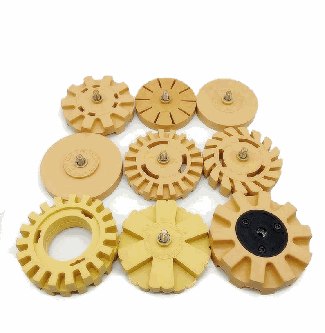
It's a routine operation before painting or dent repair: remove the parts cleanly, then finish cleaning off the adhesive residue with a drill-mounted eraser wheel.
What about glass, and paintless dent repair?
There are induction systems on the market designed for removing bonded glass: a plate heats the metal frame under the adhesive bead to soften it. These are dedicated tools, with flat heads and fine power adjustment. A portable heater designed for fasteners, which takes a part to 700 °C or more, isn't made for this, and the risk of cracking the glass or damaging the paint on the frame is real. For glass, stick to the intended methods and tools.
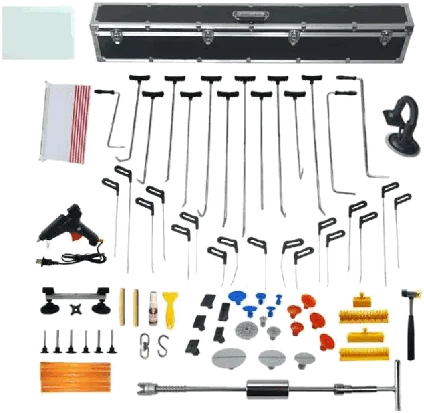
The same caution applies to paintless dent repair. Some techniques use very controlled heating of the panel to release stresses on shallow dents, with specific tools. With a fastener heater, the paint blisters in an instant. In paintless dent repair, induction is mainly useful for removing badges and mouldings before starting work, and the rest is done with rods and glue.
For glue pulling, for that matter, heat also helps release the tabs, but a few drops of isopropyl alcohol at the base of the tab are usually enough, without heating the panel. And on a typical car park dent, good PDR lighting, the right rods and patience do more than any heat source.
Safe use
The heated part becomes scorching hot and stays that way for several minutes: wear suitable gloves and use long-handled tools. Remove metal watches, rings and bracelets before using the coil, as they would heat up too. People with a pacemaker or an electronic medical implant must take note of the manual, as with any device generating a magnetic field.
Also respect the tool's duty cycles. Portable heaters have thermal protection that cuts out in the event of overheating: if it trips, let it cool down with the fan running rather than persisting.
- Coil as close as possible to the part, without contact
- Watch, rings and bracelets removed
- Looms, hoses and tanks kept clear
- Short, controlled heating near paint
Induction heating from Humming
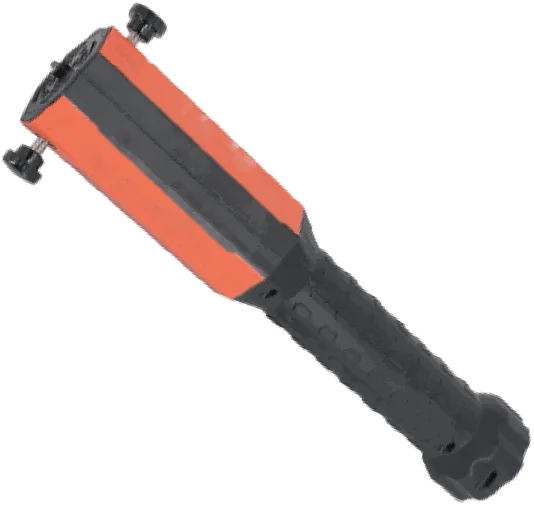
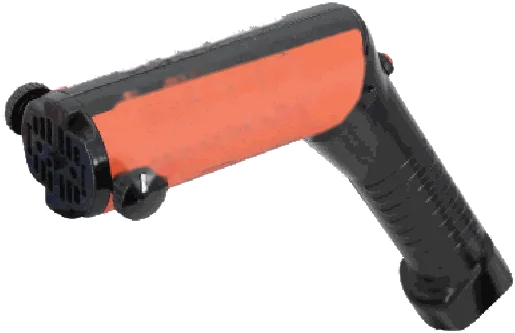
Humming Equipment offers two formats: the HE-H601 stick heater and the HE-H602 gun heater, from 1,000 to 1,500 W depending on the version, which take the part to 700–900 °C. They come in a carry case with three coils (Ø 15, 20 and 30 mm) and a one-metre flexible coil, and other coil shapes are available as options. To finish cleaning off adhesive, there's the ACC-116 eraser wheel. Your Humming distributor will recommend the version best suited to your use.
The values given here are workshop guidelines. The product's technical data sheet always takes precedence.